Spend a few minutes talking to farmers who have been working the same land for twenty or thirty years, and you will notice something. Very few conversations about irrigation start with technology. They usually start with water. Then electricity. Then the challenges that come with both.
For a long time, irrigation schedules often depended on when power was available rather than when crops actually needed water. If electricity arrived late at night, pumps ran late at night. If the supply was interrupted, irrigation plans changed. Simple as that.
Solar energy is gradually changing this reality.
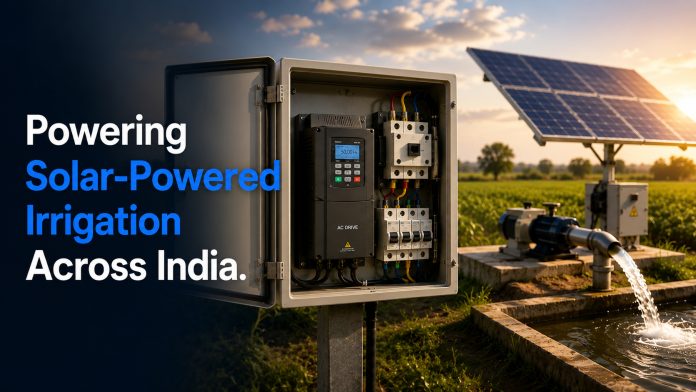
Across many parts of India, solar-powered pumps are becoming a familiar sight. But the panels mounted near a field are only the visible part. Behind those systems are drives, starters, and protection devices that quietly help everything run smoothly. Without them, reliable irrigation would be much harder to achieve.
The Rise of Solar-Powered Irrigation in India
A farmer standing beside a solar-powered pump today is having a very different experience from a farmer ten years ago.
That might sound dramatic. It isn’t.
Not long ago, diesel costs were a constant concern and grid power availability often dictated irrigation schedules. Many farmers simply worked around whatever electricity they could get.
The growing adoption of the solar powered irrigation system is changing that pattern. Water pumping is becoming more predictable, operating costs are becoming easier to manage, and dependence on fuel is gradually decreasing. Government initiatives have certainly encouraged adoption, but technology has also matured significantly.
Installing solar panels is only one part of the equation. A reliable solar irrigation system depends on efficient motor control, dependable protection, and equipment that can handle demanding agricultural conditions season after season.
Understanding the Components of a Solar Irrigation System
From a distance, most solar irrigation setups look fairly simple. Panels. A pump. Water is flowing into the field. The reality is a little more interesting. Several electrical and control components work together behind the scenes to keep the system operating efficiently.
Solar Panels and Water Pumps
Everything starts with energy generation.
Solar panels convert sunlight into electricity, which is then used to operate pumping equipment. Depending on the application, this may involve surface pumps, submersible pumps, or borewell installations. Solar irrigation systems may use either DC pumps, which operate directly from solar panels, or AC pumps, which are powered through an inverter or AC drive. AC drives therefore play a critical role in installations using AC motors by providing efficient motor control and performance optimisation. Together, these elements create a solar powered water pumping system capable of supplying water without relying entirely on conventional electricity sources.
Motor Control Equipment
Pumps rarely operate under identical conditions every day. Sunlight changes. Water demand changes. Operating requirements change.
This is why motor control equipment plays such an important role. By helping motors respond to varying conditions, control systems improve efficiency and reduce unnecessary stress on pumping equipment. Small adjustments often make a surprisingly big difference over time.
Protection Components
Agricultural installations face challenges that factory environments don’t always experience. Dust. Heat. Moisture. Voltage fluctuations.
Protective devices help keep equipment safe when these conditions occur. While they may not attract much attention, they often determine whether a system continues operating reliably during peak irrigation periods or experiences costly downtime.
Since agricultural equipment operates outdoors, many electrical components are housed in high IP-rated enclosures, such as IP55 or IP65, to protect against dust, moisture, rain, and other harsh environmental conditions, improving long-term reliability.
The Role of AC Drives in Solar-Powered Irrigation
Anyone who has spent time around irrigation pumps knows one thing. Conditions rarely remain constant.
A bright afternoon and a cloudy morning create very different operating environments. Motors need a way to adapt.
Making Better Use of Available Solar Energy
One of the biggest advantages of AC drives for solar pumps is their ability to work with changing solar conditions.
Instead of demanding fixed operating conditions, the drive adjusts motor performance based on available energy. This allows pumps to continue functioning even when sunlight intensity fluctuates. For farmers, that often means more productive pumping hours throughout the day.
In addition to adjusting motor speed, AC drives maintain an appropriate voltage-to-frequency (V/f) ratio. This helps protect motors from overheating, excessive current, and inefficient operation when solar power output fluctuates due to changing sunlight conditions.
Improving Pump Efficiency
Think about a vehicle travelling downhill. It doesn’t always need maximum engine power. Pumps are similar.
When motors operate at speeds higher than necessary, energy is wasted. AC drives help optimise performance by matching motor speed to actual requirements. This approach reduces unnecessary consumption while improving overall pumping efficiency.
Supporting Consistent Water Delivery
The challenge with solar power isn’t generating electricity. The challenge is managing variation.
Cloud movement, seasonal weather changes, and changing sunlight conditions all influence power generation. AC drives help smooth these fluctuations, making the solar powered irrigation system more stable and predictable throughout daily operation.
How Motor Starters Improve Pump Reliability
Farmers usually notice starters only when they stop working. This is actually a compliment. Good starters do their job quietly, protecting motors every time they start and stop.
Reducing Stress During Motor Starting
Starting a motor creates a sudden electrical and mechanical load.
Over months and years, repeated stress can affect both the motor and the connected pumping equipment. Starters help manage this process more effectively, reducing impact and improving overall equipment reliability.
Providing Essential Protection
Electrical supply isn’t always perfect.
Voltage fluctuations, phase failures, and abnormal operating conditions occur more often than many people realise. Modern starters provide protection against these issues, helping prevent avoidable damage and reducing maintenance requirements.
Extending Equipment Life
Nobody wants to replace a pump earlier than necessary.
Proper starting and protection reduce wear on motors and associated equipment. Over time, these improvements contribute to longer service life and more dependable irrigation performance, particularly during periods when water demand is high.
Why MCBs are Essential in Solar Irrigation Systems
Protection devices rarely get much attention during system installation. People focus on panels. Pumps. Controllers. Then a fault occurs, and suddenly protection becomes very important.
Preventing Overload Damage
Electrical overloads can happen for several reasons. Mechanical problems, abnormal operating conditions, or unexpected changes in load may cause excessive current flow. A properly selected MCB for solar irrigation systems helps disconnect circuits before overheating damages equipment. It is a simple function, but an extremely important one. MCBs are commonly used for low- to medium-current circuit protection and are often installed alongside other protective devices such as surge protection devices (SPDs), isolators, or MCCBs in larger solar irrigation installations to provide comprehensive electrical protection.
Protecting Against Short Circuits
Short circuits are rare. When they happen, they happen fast. Damaged cables, moisture ingress, or accidental wiring faults can create dangerous conditions within an installation. Circuit breakers respond quickly, helping minimise damage and improve system safety.
Improving Operational Reliability
Reliable irrigation depends on reliable electrical systems. Protection devices help isolate faults before they affect larger sections of the installation. Products such as Lauritz Knudsen’s AU MCB, Exora MCB, and Tripper MCB ranges provide dependable protection that supports uninterrupted operation across agricultural applications.
Supporting Safer Agricultural Installations
Safety sometimes becomes an afterthought in irrigation discussions. It shouldn’t.
Protection devices reduce electrical risks for both equipment and users. As more farms adopt advanced pumping technologies and solar pumps for irrigation, maintaining safe operating conditions becomes increasingly important.
To ensure safe and reliable operation, electrical equipment used in solar irrigation systems should comply with applicable BIS and IEC standards covering motor control, circuit protection, and overall electrical safety. Compliance with these standards helps improve system reliability and supports long-term field performance.
Conclusion
The story of solar irrigation in India is not really about solar panels alone. It’s about reliability.
Farmers need water when crops require it, not when electricity happens to be available. Solar energy is helping make that possible, but only when the supporting electrical infrastructure is equally dependable.
AC drives help optimise motor performance by maintaining appropriate motor speed and voltage-frequency ratios even under varying solar input conditions. Starters improve reliability and protection. MCBs safeguard equipment from electrical faults and work alongside devices such as SPDs, isolators, and MCCBs where higher levels of protection are required. Together, they contribute significantly to the benefits of solar power irrigation system adoption across agricultural communities.
With solutions such as the xD1000, xD2000, xD3000, and xD4000 AC drives, agricultural motor starters, and protection products including AU MCB, Exora MCB, and Tripper MCB, Lauritz Knudsen Electrical & Automation continues to support smart irrigation system in India. As the solar irrigation system market expands and more farmers adopt solar pumps for irrigation, these technologies will remain essential to ensuring dependable water management and long-term agricultural productivity.