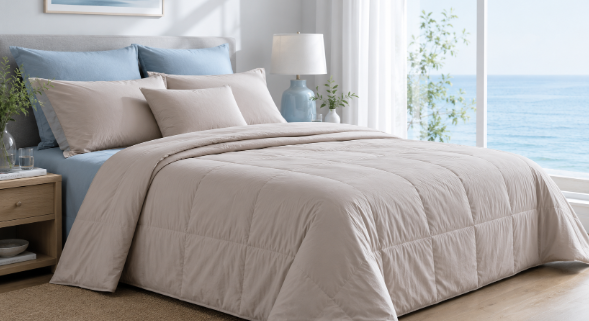
A cool bedroom helps most people sleep, but temperature alone does not explain why the same room feels comfortable one night and stifling the next. Humidity is the second variable, and inside a bed the bedding controls it more than the room does. If you wake up warm and slightly damp in a room that is objectively cool, the problem is vapour that cannot escape your bedding — usually the shell of your down comforter — rather than the thermostat setting.
Sleep researchers generally point to a cool, well-ventilated bedroom as the better environment for sleep, and most guidance clusters in the cooler part of the comfortable range rather than the warmer part. But that advice is about the room. What your body actually experiences is the microclimate inside a few centimetres of textile, and that is a different system with different rules.
The microclimate is not the room
Your body sheds both heat and moisture all night. Heat leaves relatively easily. Moisture is the harder problem, because it has to pass as vapour through every layer between your skin and the air — sheet, cover, comforter shell — before it can disperse. Of those, the down comforter shell is the largest single barrier, simply because it covers the most area.
When any of those layers resists vapour, moisture accumulates against the skin. Damp air conducts heat far better than dry air, so a humid microclimate feels warm even when the ambient temperature is low. This is the mechanism behind the most common complaint in bedding: waking hot in a cold room.
It also explains why turning the thermostat down often fails. Cooling the room does not help vapour escape a sealed layer. It just makes the rest of the room colder while the bed stays humid.
Humidity is the variable nobody measures
Most people can state their bedroom temperature and have no idea about its humidity. A basic hygrometer costs very little and is worth more than most sleep gadgets, because it turns a vague complaint into a number you can act on.
Moderate humidity is the target — dry enough that vapour moves away from you readily, damp enough that airways and skin do not dry out overnight. Very dry air causes its own problems, so this is not a case of lower being better. Once the room is in a sensible range, the remaining work happens in the bedding, which is where a temperature-regulating down comforter earns its place: the shell fabric decides how quickly vapour leaves the system, and that is a specification, not a feeling.
Two habits move the room’s number without any purchase. Ventilate in the morning instead of making the bed immediately, so the moisture released overnight leaves the bedding rather than being sealed under a smoothed-down cover. And avoid drying laundry in the bedroom, which is a surprisingly large moisture source in small apartments.
Why linen behaves differently
Linen fibre is hollow and irregular, and linen fabric is woven relatively openly. The practical effect is that it takes on moisture readily, moves it along the fibre, and releases it to the air quickly — while still feeling dry against skin at moisture levels where a smoother fabric would feel clammy.
Blended with organic cotton, that behaviour is moderated slightly: cotton adds softness and structure, linen supplies the moisture transport and the open weave. It is a deliberate trade — pure linen is more aggressively breathable and more textured, and not everyone likes sleeping on texture.
The comparison worth understanding is against a dense, highly finished cotton shell. That fabric can feel wonderful to the hand and still trap vapour, because the same finishing that produces smoothness closes the weave. The same trade shows up one layer down, where a sateen cotton sheet set gives you the smoother surface and a percale or linen weave gives you the faster moisture transport. A high thread count is not automatically a better night’s sleep; past a point it works against airflow.

The specs, in plain terms
The Warmy Tummy European Linen Goose Down Filled Comforter pairs a shell of 70% organic cotton and 30% linen at 500 thread count with a fill of 90% European white goose down from Germany at 700 fill power, held in a 3D baffle box with an extra warmth layer and anchored by corner loops, certified to OEKO-TEX® STANDARD 100, the Responsible Down Standard (RDS) and IDFL, and offered in Light, All Season and Ultra Warm across three sizes — Twin/Twin XL 68″x86″, Full/Queen 90″x90″ and King/Cal King 107″x90″.
Read that against the humidity argument and the shell blend is the line that matters most, with the 500 thread count reading as a deliberate ceiling rather than a shortfall — dense enough to contain 700 fill power down, open enough to let vapour through. The corner loops are a smaller but real detail, because a down comforter that shifts inside its cover produces uneven layers, and uneven layers produce exactly the warm damp pockets this article is about. The certifications answer separate questions: OEKO-TEX® STANDARD 100 covers tested substances in the finished textile, the Responsible Down Standard (RDS) covers the sourcing chain behind the fill, and IDFL is the independent laboratory that verifies down and feather content.
Building the stack for a stable microclimate
Work outward from your skin. Sheets first, because they are in contact all night — open weaves such as percale and linen move moisture faster than sateen. Then the cover, where the same rule applies and where most people unknowingly undo the comforter’s breathability by wrapping it in a dense decorative fabric. Then the down comforter itself: warmth level for the season, shell fabric for the moisture. Those two specifications are independent of each other, and confusing them is why so many people end up with a lighter down comforter that still sleeps damp.
If you share the bed with someone whose comfort range differs from yours, the humidity lever is usually more effective than the temperature lever, because it can be adjusted per-person by changing sheets and covers rather than by fighting over a thermostat. Shopping this way means reading fabric specifications rather than descriptions, and bedding chosen for airflow is a narrower starting point than a general catalogue when overheating is the problem you are solving.
Where this advice stops
Bedding cannot fix a genuinely damp room. If your hygrometer reads high all day, not just after sleep, the source is the building — ventilation, drying laundry, an unvented bathroom — and no down comforter will compensate. Likewise, waking hot with sweating that soaks through bedding, or that started suddenly, is worth raising with a doctor rather than solving with textiles. And a linen-blend shell is a trade: it feels cooler and more textured than sateen, which some people simply prefer not to sleep on. The Warmy Tummy European Linen Goose Down Filled Comforter suits a warm, humid sleeper better than it suits someone who runs cold and wants the smoothest possible surface.
FAQ
What is the ideal bedroom temperature and humidity for sleep?
Most guidance points to a cool, well-ventilated room with moderate humidity — dry enough that moisture moves away from your skin, not so dry that airways and skin suffer. Exact preferences vary by person and season. A basic hygrometer is more useful than precise targets, because it tells you which of the two variables is actually out of range.
Why do I wake up hot in a cold room?
Because the microclimate inside your bedding is humid, not because the room is warm. Damp air conducts heat far better than dry air, so trapped vapour feels hot even at low ambient temperatures. The fix is a more breathable stack — an open-weave sheet, a lighter cover, and a comforter shell that lets vapour through — rather than a lower thermostat setting.
Is a linen down comforter good for hot sleepers?
Generally yes. Linen’s open weave and strong moisture affinity move vapour away faster than dense, highly finished cotton, which is what usually causes overheating. The trade-off is texture: linen blends feel crisper and less silky than sateen. If you sleep hot and damp, that trade is worth making; if you sleep cold and want smoothness, it is not.