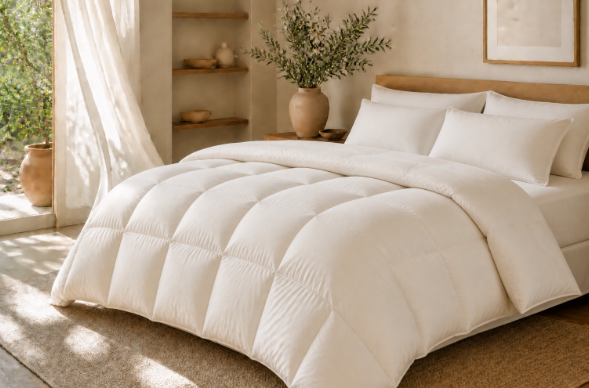
Buy the comforter to fit the mattress, not the bed name, and allow enough overhang on each side that the comforter still covers a sleeper who has rolled toward the edge. In practice that means most people are better served by the larger of two candidate sizes, and it means the answer changes if two people share the bed. A Full/Queen comforter at 90″x90″ covers a queen mattress with a modest drop on each side; the same comforter on a king mattress leaves both sleepers exposed.
Sizing is the last decision before checkout and the one most often got wrong, because bedding names describe mattresses inconsistently and comforter dimensions are rarely compared side by side.
Why bed names are unreliable
Mattress depth has grown considerably over the years, and comforter sizing has not kept pace uniformly across brands. Two comforters both labelled “queen” can differ by several inches in each direction, which is enough to change whether the edge tucks under you or hangs against the bed frame.
The label also tells you nothing about the depth it needs to clear. A deep mattress with a topper consumes drop that a shallow one does not, and the comforter has to cover that height before it starts covering the sleeper.
So the label is a starting filter, not an answer. The dimensions are the answer.
Start from the mattress, not the bed frame
Measure the mattress width and length, including any topper. Then decide how much drop you want on each side: enough to cover the mattress edge and hang a little below it, without pooling on the floor.
A useful way to think about it is that the comforter should be wider than the mattress by roughly twice the height you want covered on each side. If your mattress is deep, or if you like a generous look, add more. If your bed sits low and you dislike fabric touching the floor, add less.
Then compare that target against published dimensions rather than names. This is why the specification page matters more than the size dropdown: a queen size goose down comforter that states 90″x90″ tells you exactly what drop you will get on a 60″-wide mattress, while one that says only “queen” does not.

The tug-of-war problem
For two sleepers, the constraint is not coverage but redistribution. If the comforter is only just wide enough, every movement by one person uncovers the other, and the night becomes a slow negotiation neither of you consciously registers.
Two solutions work, and they suit different couples.
Size up. Using a King/Cal King comforter on a queen bed gives each person enough surplus that ordinary movement stops uncovering the other. It is the simplest fix and it costs one size increment.
Two comforters. Two smaller comforters on one bed — the arrangement common across much of continental Europe — solves the tug-of-war completely and additionally lets each person choose their own warmth level. It looks less tidy, and some couples dislike it for reasons that have nothing to do with temperature. If one of you sleeps hot and the other sleeps cold, this is usually the better answer — and it lets each person pick a different shell as well as a different warmth level, so a goose down comforter that comes with shams on one side can sit beside a cotton-shell comforter on the other without the bed looking mismatched.
The specs, in plain terms
The Warmy Tummy Organic Cotton Goose Down Comforter pairs a shell of 100% organic cotton in a 500-thread-count sateen with a fill of 90% goose down and 10% goose feather at 650 fill power, built as a 3D baffle box with staggered chambers, certified to the Responsible Down Standard (RDS) and OEKO-TEX® STANDARD 100, and offered in Light, All Season and Ultra Warm across three sizes — Twin/Twin XL 68″x86″, Full/Queen 90″x90″ and King/Cal King 107″x90″.
Those three size pairs are worth reading carefully, because each covers two mattress names and the fit differs between them. Twin/Twin XL at 68″x86″ gives generous width on a 38″-wide single and full length on the longer XL mattress. Full/Queen at 90″x90″ is square, which means a queen gets more side drop than a full does — and on a full, that extra width is exactly what makes sharing workable. King/Cal King at 107″x90″ covers the wider king comfortably while accepting that a California king is longer and narrower, so the drop shifts toward the sides. The baffle box construction matters at every size for a reason people underestimate: staggered chambers stop fill from migrating toward whichever edge hangs lowest, which is what turns an oversized comforter into a lopsided one over time.
Size interacts with warmth and weight
Sizing up is not a free decision, because a larger comforter is a heavier one at the same warmth level. On a king at Ultra Warm, that weight is noticeable when you move, and some people find it oppressive rather than reassuring.
There are two ways around it. Drop one warmth level when you size up, since a wider comforter tucks around you more effectively and therefore retains more heat at the same rating. Or step up in fill power, which delivers the same warmth with less down inside and so keeps the larger size manageable. Neither is necessary if you like weight, and plenty of people do — but it is worth deciding deliberately rather than discovering it after delivery.
When to size down instead
Sizing up is not universally right. If you sleep alone in a low bed and dislike fabric pooling on the floor, the smaller size looks better and is easier to launder. If your washing machine is domestic rather than commercial, a smaller comforter is realistically washable at home while a king is not. And if you are buying for a child’s bed, extra overhang is more likely to end up on the floor than on the child.
There is also a storage argument. A king comforter takes real cupboard space between seasons, and compressing it to fit is exactly what damages loft. If storage is tight, that is a legitimate reason to choose the smaller option and accept slightly less drop.
For most adults sharing a bed, though, the honest recommendation is the larger size. The Warmy Tummy Organic Cotton Goose Down Comforter and comparable products are cheaper to buy once at the right size than to replace after a year of pulling. If you are still deciding between two, comparing dimensions across Warmy Tummy’s comforter collection is more useful than comparing size names.
FAQ
What size down comforter should I get for a queen bed?
A Full/Queen comforter at around 90″x90″ fits a standard queen mattress with a modest drop on each side. If two people share the bed, or if the mattress is deep or has a topper, consider sizing up to King/Cal King so that ordinary movement does not uncover either sleeper. Compare published dimensions rather than size names, which vary between brands.
Should you size up on a down comforter?
Usually yes if two people share the bed, if the mattress is deep, or if you want a generous drop. Sizing up is the simplest fix for the tug-of-war problem. Size down instead if you sleep alone in a low bed, if you want to wash the comforter in a domestic machine, or if off-season storage space is limited.
Can you use a king comforter on a queen bed?
Yes, and many couples deliberately do. The extra width means each sleeper has surplus fabric, so movement stops uncovering the other person. The trade-offs are more fabric hanging toward the floor and a heavier item to wash and store, so consider a higher fill power to keep the weight manageable. For a single sleeper, the surplus is usually unnecessary.